New Noise Blanker
Introduction
During September and October 2026 new noise blankers have been implemented to improve what was a weak part of the SDR Console signal processing chain. Using the knowledge of ChatGPT, this exercise took only five days and the result is shown below. These noise blankers will be available sometime in October 2026.
Impulse Noise
A noise blanker should remove Impulsive interference such as electrical switching noise, electric-fence pulses, ignition interference and short static crashes
The screenshot below shows the new wideband noise blanker in action.
- The top half of the main waterfall shows the noise created by an electric fence,
- The bottom half shows the noise removed by the new wideband noise blanker.
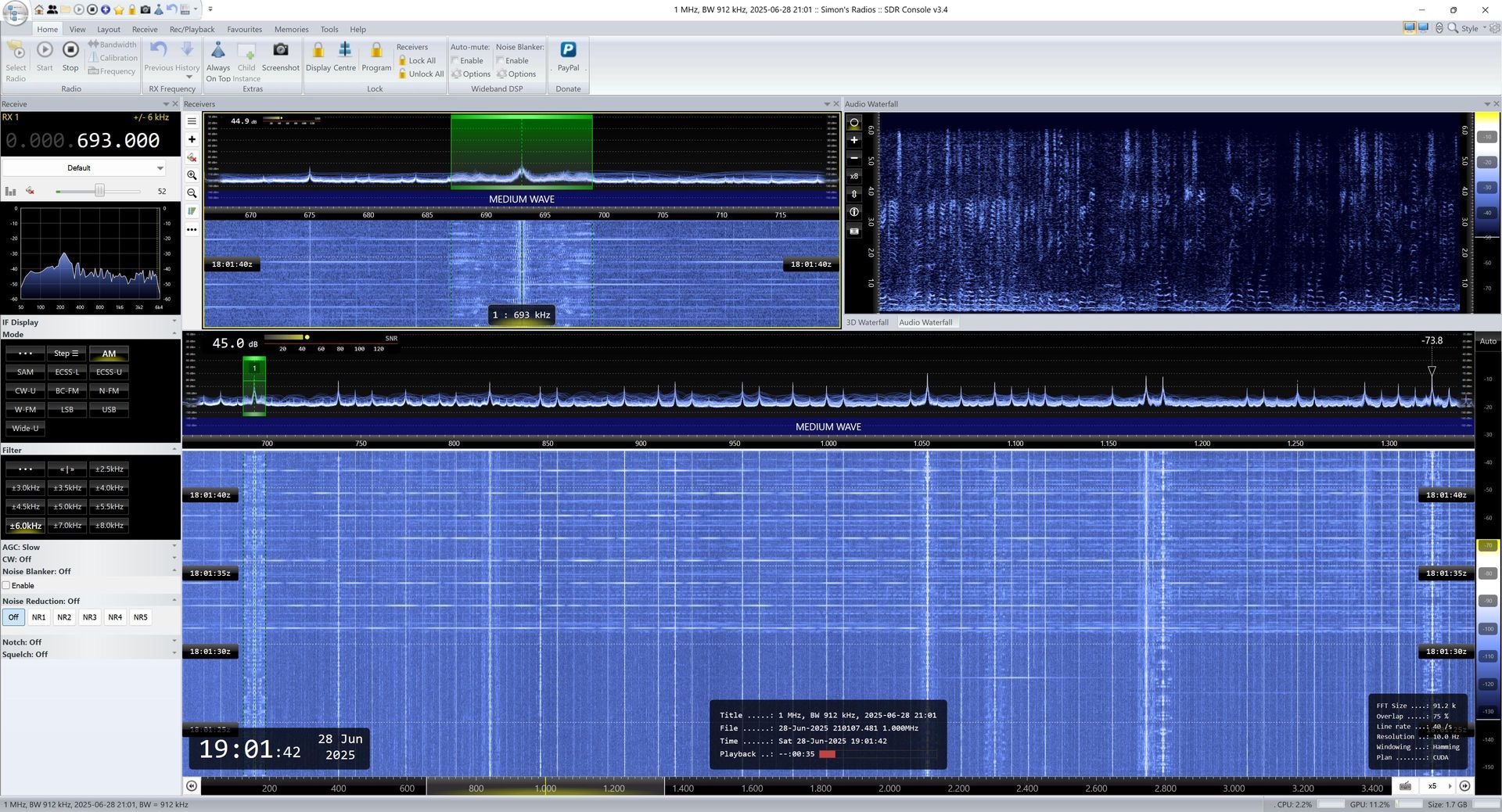
Listen to a recording made using AM on 1,287kHz, a signal is present. In the recording the wideband noise blanker is engaged after 10 seconds then disengaged after 20 seconds. The result is good!
Listen to a recording made using AM on 709kHz, there is no signal present, just noise. In the recording the wideband noise blanker is engaged after 15 seconds.
Receiver Noise Blanker
Predictive Impulse Repair
Predictive Impulse Repair (PIR) is a new noise-blanking technique designed to remove short-duration impulsive interference such as electrical switching noise, electric-fence pulses, ignition interference and static crashes. Unlike a conventional noise blanker, PIR does not simply mute or zero the samples affected by an impulse. Instead, it identifies the damaged region and attempts to reconstruct the original complex IQ waveform using the undamaged signal immediately before and after the disturbance.
Impulse detection is performed in the complex IQ domain by looking for sudden changes that are inconsistent with the recent behaviour of the received signal. Adaptive background measurements allow the detector to distinguish normal signal variations from genuinely impulsive events over a wide range of signal levels. Additional amplitude-envelope analysis helps identify disturbances that might otherwise be difficult to detect, while rejecting normal modulation as far as possible.
Once an impulse has been identified, PIR determines the extent of the damaged region and replaces it using information from the surrounding clean IQ samples. Very short disturbances can be repaired by interpolation, while longer events use bidirectional predictive reconstruction. Predictions are made from both sides of the damaged region and smoothly combined, preserving both amplitude and phase continuity through the repair.
This is fundamentally different from traditional noise blanking. A conventional blanker deliberately creates a gap in the received waveform; PIR instead tries to repair the gap. This is particularly effective with SSB reception, where abrupt blanking can itself produce audible clicks and distortion. The result is that strong impulsive interference can often be removed with remarkably little indication that an impulse was ever present.
Predictive Impulse Repair operates on the complex IQ signal before demodulation, so the repair is performed while both amplitude and phase information are still available. It is modulation-independent and can therefore be used ahead of SSB, AM, SAM and other demodulators. In testing with SSB signals affected by severe repetitive impulse interference, the reconstructed audio can remain continuous even where conventional blanking would produce clearly audible artifacts.
Wideband Noise Blanker
The Wideband Noise Blanker in SDR Console is designed to suppress short-duration impulsive interference before it reaches individual receivers or the spectrum display.
Typical sources of impulsive interference include electric fences, ignition systems, switching equipment, electrical machinery, thermostats, power-line faults and atmospheric static. These disturbances can produce very short but extremely powerful bursts of RF energy which may cover a large part, or even all, of the received spectrum.
Unlike a conventional noise blanker which simply removes or zeros samples, the SDR Console Wideband Noise Blanker detects the damaged section of the received IQ data and attempts to replace it with a reconstructed signal.
This technique is referred to as Predictive Impulse Repair (PIR).
Why Wideband?
The important difference between this noise blanker and a conventional receiver noise blanker is where the processing takes place.
The Wideband Noise Blanker operates directly on the incoming wideband complex IQ data, before the data is sent to the spectrum display and before individual receivers are extracted from the wideband data.
The processing chain is approximately:
SDR wideband IQ
|
v
Wideband Noise Blanker
|
+--------> Spectrum / Waterfall
|
+--------> Receiver 1
|
+--------> Receiver 2
|
+--------> Receiver 3
|
+--------> ...
This has an important advantage. An electrical impulse is normally broadband. If several receivers are operating within the same SDR bandwidth, the same impulse may be heard simultaneously in every receiver and may also appear as a vertical line on the waterfall. By detecting and repairing the impulse in the original wideband IQ stream, the interference is removed before the individual receivers see it.
One operation can therefore improve all receivers using that IQ stream as well as reducing impulsive interference visible on the spectrum and waterfall displays.
Processing
Impulsive Interference
An impulse can be extremely short in time while containing energy across a very wide range of frequencies. On a waterfall display this often appears as a vertical line because a single disturbance affects many frequencies simultaneously.
An electric fence is a good example. The fence produces a powerful electrical discharge at regular intervals. Although the disturbance may last only a fraction of a millisecond, its amplitude can be much greater than the wanted signals.
A traditional noise blanker attempts to detect this event and suppress it. The difficulty is deciding exactly which samples have been damaged. Remove too few samples and part of the impulse remains. Remove too many and useful received signal is unnecessarily destroyed.
The Wideband Noise Blanker therefore uses an adaptive detector which continuously examines both the received signal power and how well each new complex IQ sample agrees with the recent signal behaviour.
Adaptive Impulse Detection
The detector does not simply look for samples exceeding a fixed amplitude. A fixed threshold performs poorly with SDR signals because the received signal level and spectral occupancy can vary considerably. Instead, the Wideband Noise Blanker continuously estimates the normal background behaviour of the wideband IQ stream.
For each incoming complex sample it examines the difference between the actual sample and the value expected from immediately preceding samples. This difference is called the prediction residual.
During normal reception the residual follows the statistical behaviour of the received wideband signal.
When a sudden electrical impulse occurs, the received IQ can change far more rapidly than would normally be expected. The prediction residual can then increase dramatically.
The detector combines this residual measurement with signal-power information. This helps distinguish genuine impulsive interference from ordinary changes in the received signal.
The background estimates continuously adapt, so the detector automatically follows changes in normal received signal conditions.
Finding the Damaged Region
Detecting the peak of an impulse is only part of the problem. The samples immediately before and after the strongest part of the impulse may also have been corrupted. SDR Console therefore identifies a strongly detected core of the impulse and then examines a limited region around it to estimate where the damaged waveform actually begins and ends. This prevents a short impulse from being incorrectly expanded into a much longer event while still allowing the lower-energy edges of the disturbance to be included in the repair.
This distinction proved particularly important with real wideband recordings. The strongest portion of an electrical impulse may be very short, while the complete disturbed region can extend for considerably longer.
Predictive Impulse Repair
Once the damaged region has been identified, simply setting those IQ samples to zero is not ideal. A sudden transition from the received signal to zero, followed by another sudden transition back to the received signal, is itself a discontinuity. In the frequency domain this discontinuity can create additional broadband energy. Instead, the Wideband Noise Blanker uses the undamaged complex IQ surrounding the impulse to construct replacement samples.
SDR Console calls this technique Predictive Impulse Repair.
Clean IQ samples immediately before and after the damaged region are examined. The behaviour of the complex signal on both sides is used to predict into the missing region. A prediction is made forward in time from the clean signal preceding the impulse and backwards in time from the clean signal following the impulse. The two predictions are then smoothly combined across the damaged interval.
Conceptually:
Clean IQ Damaged IQ Clean IQ
--------- | X X X X X X X X | ------------
\ /
\ /
Forward Backward
prediction prediction
\ /
\ /
Reconstructed IQ
The objective is not to claim that the original RF waveform can always be recovered perfectly. Once interference has completely overwhelmed the receiver, the original information in those samples may no longer exist.
Instead, the objective is to replace a very large impulsive disturbance with a waveform which is consistent with the clean signal surrounding it and which does not itself introduce another sharp discontinuity. For impulsive interference this can be remarkably effective.
Look-Ahead Processing
Predictive repair requires samples from both sides of an impulse.
This means the Wideband Noise Blanker must wait briefly for clean samples following the disturbance before it can reconstruct the damaged region. SDR Console therefore uses a small amount of look-ahead buffering.
The additional latency is approximately 0.3 milliseconds, which is insignificant for normal receiver operation but gives the repair algorithm access to clean IQ following the impulse.
The processing is fully streaming. The number of samples entering and leaving the noise blanker remains the same; the output is simply delayed slightly to provide the required look-ahead.
Maximum Impulse Duration
There is an important limitation to any impulse-repair algorithm. If interference destroys a sufficiently long section of the received signal, there is no mathematical method which can recreate arbitrary missing wideband RF information perfectly. For this reason SDR Console deliberately limits the duration of an event which will be automatically reconstructed.
The current Wideband Noise Blanker is designed to repair impulses up to approximately 200 microseconds. This is long enough to handle many severe electrical impulses while avoiding increasingly speculative reconstruction of much longer disturbances. Events exceeding the permitted duration are left unchanged. This is particularly relevant to atmospheric noise.
A lightning discharge can produce anything from a relatively short impulse to a much longer static crash. The short impulsive components may respond well to Wideband Noise Blanking, but a long crash may contain hundreds of microseconds or several milliseconds of corrupted data.
There is simply not enough information available to reconstruct such a long section of arbitrary wideband RF accurately. The Wideband Noise Blanker is therefore intended primarily for impulsive interference, not continuous noise or long-duration interference.
Electric Fence Interference
Electric-fence interference has been particularly useful during development because it provides strong, repeatable real-world impulses. Testing was performed using recorded wideband IQ containing a powerful electric-fence pulse approximately once per second. The detector identifies the short electrical disturbances automatically. Some of the strongest events occupy considerably more than 100 microseconds of IQ data.
With Predictive Impulse Repair enabled, these pulses can be reconstructed at the wideband IQ level before the data reaches the receivers. The result is especially useful because the interference does not have to be independently detected by every active receiver. It is repaired once at the source.
Spectrum and Waterfall
Because processing occurs before spectrum generation, the Wideband Noise Blanker can also reduce the characteristic vertical streaks produced by broadband electrical impulses on the waterfall. This is an important difference from an audio noise blanker.
An audio noise blanker may make a particular receiver more pleasant to listen to, but the original impulse is still present in the SDR's wideband IQ and therefore remains visible on the spectrum and waterfall.
Wideband processing attacks the interference earlier in the signal chain.
Independent of Demodulation Mode
The Wideband Noise Blanker operates on complex IQ before demodulation, so it does not need to know whether a receiver is subsequently using:
- SSB
- CW
- AM
- Synchronous AM
- FM
- Digital modes
The impulse detection and repair take place before these modulation-specific operations. This makes Wideband Noise Blanking particularly useful when several receivers using different modes are active simultaneously.
Threshold
The Threshold control determines how sensitive the detector is to impulsive events.
- A lower threshold makes the detector more sensitive and therefore more likely to classify unusual signal transitions as interference.
- A higher threshold makes detection more conservative.
The default setting has been selected to provide good detection of strong electrical impulses without unnecessarily modifying normal wideband IQ.
As with any noise blanker, the optimum setting can depend on the type of interference and the signals being received.
Increasing sensitivity too far can cause legitimate signal transitions to be mistaken for interference, so the lowest possible threshold is not necessarily the best setting.
Maximum Width
The Maximum Width setting determines the longest detected event which the Wideband Noise Blanker is permitted to reconstruct.
Short impulses are ideal candidates for repair because clean IQ exists very close to both sides of the damaged region.
As the duration increases, predicting the missing wideband waveform becomes progressively less certain.
The maximum width therefore provides an important safeguard: events longer than the selected duration are detected but are not reconstructed.
A value around 200 microseconds accommodates the strong electrical impulses encountered during development while remaining conservative about much longer disturbances.
What the Wideband Noise Blanker Cannot Do
The Wideband Noise Blanker should not be confused with general-purpose noise reduction. It cannot remove ordinary receiver noise, atmospheric background noise, adjacent-channel interference or continuous electrical interference.
It also cannot recover information which has been completely destroyed by a long-duration disturbance.
Its purpose is much more specific: detect short, abnormal, broadband impulsive disturbances and replace the damaged IQ with a smoother estimate derived from the surrounding clean signal.
When the interference matches this description, processing the original wideband IQ has a major advantage over trying to remove the resulting clicks independently from every receiver.
Wideband and Receiver Noise Blanking
Wideband and receiver-level noise reduction solve related but different problems.
A receiver-level blanker operates after the SDR has selected and filtered a particular receiver bandwidth. It has much less bandwidth to analyse and may therefore be able to make use of characteristics specific to that receiver.
The Wideband Noise Blanker sees the complete SDR bandwidth instead. Its task is more difficult because the wideband IQ may contain many signals simultaneously, but successful repair benefits everything downstream.
The two approaches are therefore complementary rather than mutually exclusive.
Summary
The SDR Console Wideband Noise Blanker uses Predictive Impulse Repair to suppress short broadband electrical disturbances directly in the incoming complex IQ stream.
Rather than simply blanking samples, it:
- Continuously learns the normal wideband signal behaviour.
- Detects abnormal impulsive changes using signal power and prediction residuals.
- Determines the approximate beginning and end of the damaged region.
- Buffers a very small amount of future IQ.
- Uses clean IQ before and after the impulse to predict replacement samples.
- Smoothly combines forward and backward predictions.
- Passes the repaired wideband IQ to the spectrum display and all receivers.
Processing the interference at this point in the SDR signal chain means that a single repair can benefit the waterfall and every receiver using the same wideband data.
It is particularly effective against short, powerful electrical impulses such as those produced by electric fences and similar sources.
There are unavoidable limits: a sufficiently long disturbance destroys information which cannot genuinely be recreated. For this reason the algorithm deliberately restricts repair to relatively short events rather than attempting increasingly uncertain reconstruction of long static crashes.
The aim is not to manufacture information which no longer exists.
The aim is to identify a short section of IQ which has been overwhelmed by an impulse and replace that destructive transient with a well-behaved estimate based on the undamaged signal immediately surrounding it.
For suitable impulsive interference, this can make the disturbance effectively disappear before it reaches the receiver.