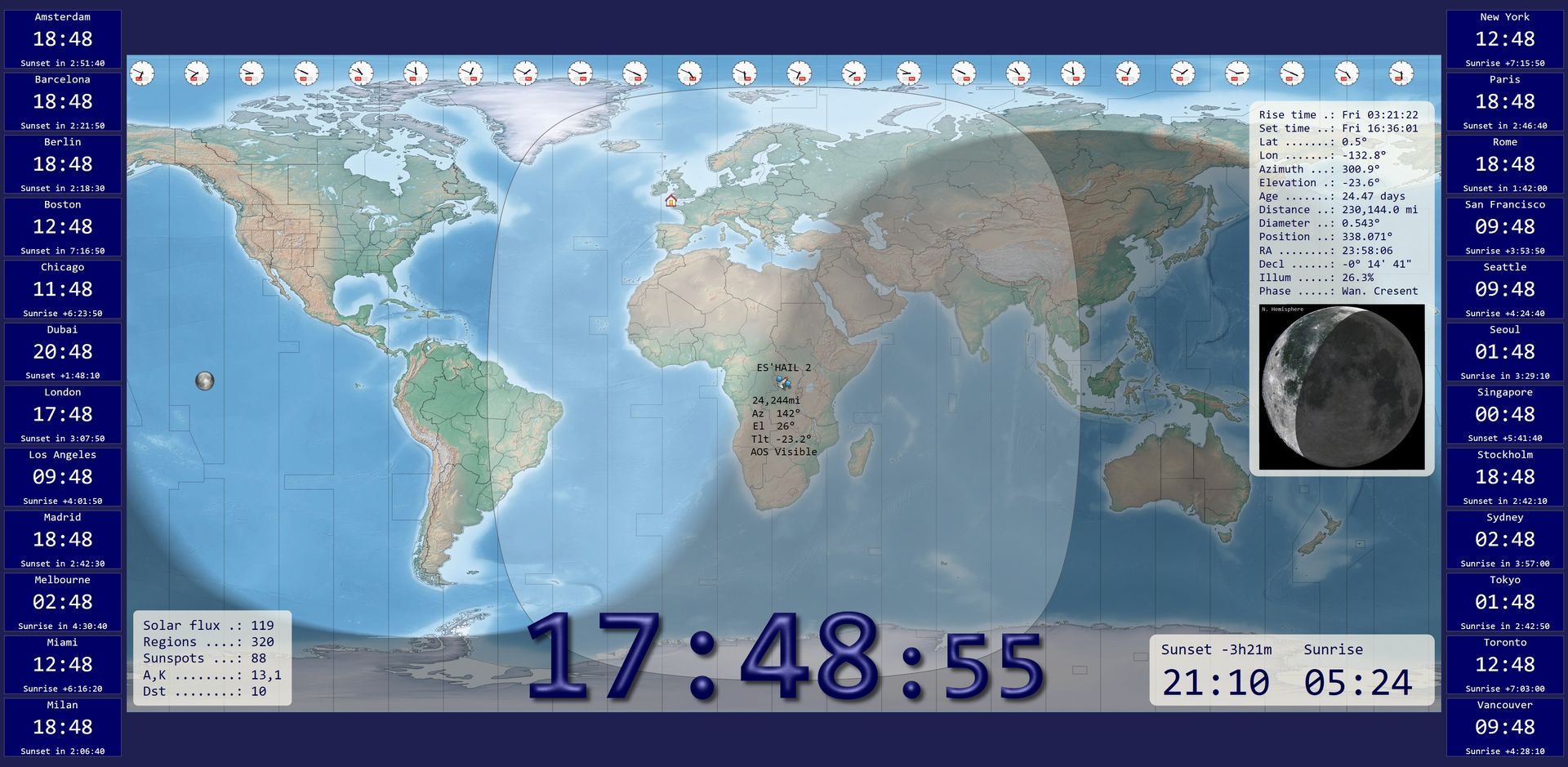
Simon's World Map 1.5

Simon Brown • May 25, 2025

UI Refresh And More...

After spending almost 18 months on the SDR Television project, Simon's World map has been given some attention.


User Interface

I find user interfaces (UI) difficult, I've never been much good at them. Here's what's changed:


  1. Ribbon Bar, Home panel:
  2. Now starts with the Home location configuration, this was previous found mixed up with the Centre buttons.
  3. Some centre icons updated.
  4. Most importantly, the Maps selection has its own panel!
  5. New Maps panel, this makes map selection far easier.

Satellites

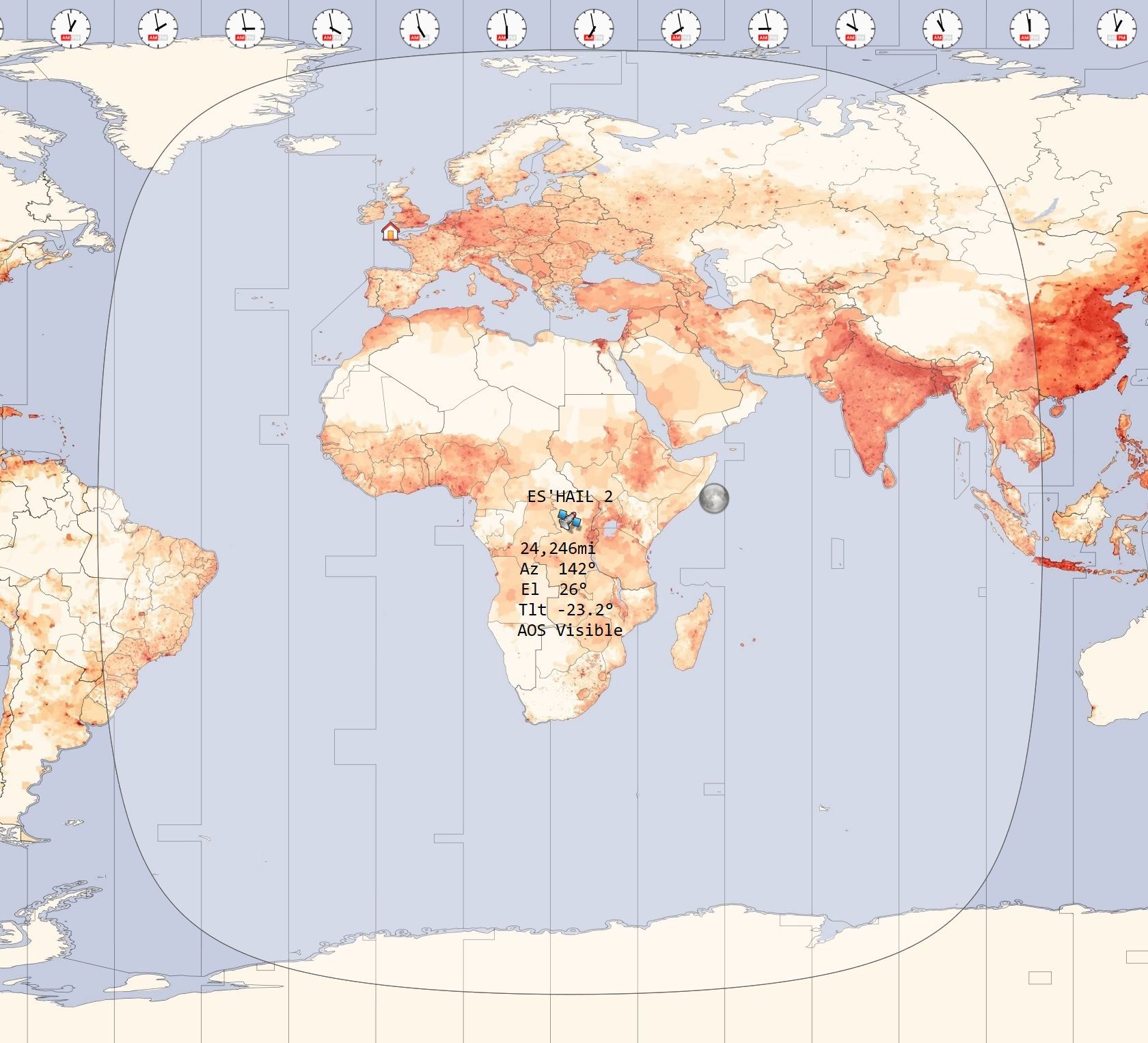
If you use the geostationary Es'hail 2 (a.k.a. Qatar-OSCAR 100 or QO-100) satellite then the LNB skew is important (the correct term is Polarisation Tilt). Although websites exist which show the skew for a given location, I wanted to know how to calculate this myself. So, many thanks to Mike G0MJW who showed me the formula. As a result the tilt is now shown as part of the satellite data. below you see a tilt value of -23.2 degrees, to compensation the LNB is rotated anticlockwise.
The formula in C++:

double dStationLatitude     = 50.10496000; // In degrees, North

double dStationLongitude    = -5.12795000; // In degrees, West

double dLongitudeDifference = dStationLongitude - dSatelliteLongitude; // In degrees

double dRadian              = RADIANS_TO_DEGREES;


double dTan  = tan(dStationLatitude/dRadian);

double dSin  = sin(dLongitudeDifference/dRadian);

double dSkew = dRadian * atan(dSin/dTan);


Now have the skew in degrees.

Stations

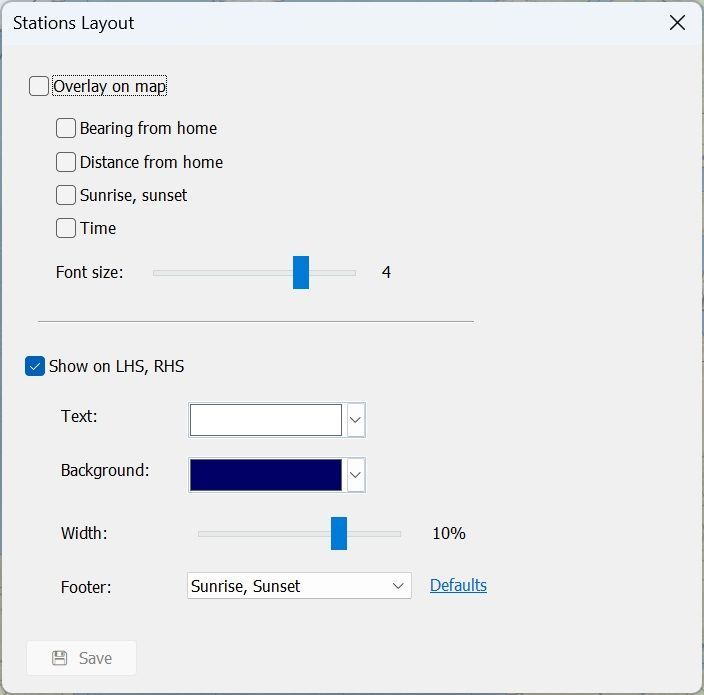
This has annoyed me for quite some time. Using feedback from users, the display can be configured as below. There are major changes:

  1. Stations can be shown to the left and right of the map.
  2. A database has been incorporated from Github which contains 7,322 major cities including country, region, latitude and longitude.
  3. A new default list can be selected.

Definitions

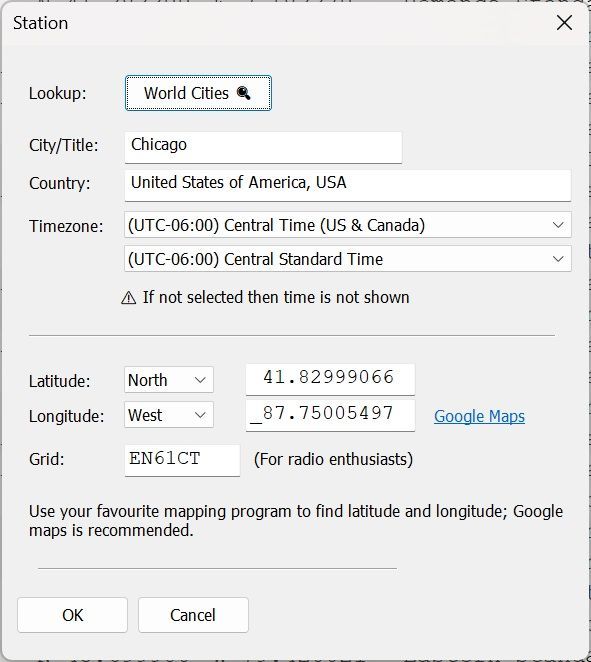
From the ribbon bar, select Stations, Show, Definitions; the approach should be intuitive. When you create or modify a definition a new option is available: World Cities.


The data is extracted from geonames, a very exhaustive list of worldwide toponyms. This datapackage only lists cities above 15,000 inhabitants. Each city is associated with its country and subcountry to reduce the number of ambiguities. Subcountry can be the name of a state (eg in United Kingdom or the United States of America) or the major administrative section (eg ''region'' in France''). See admin1 field on geonames website for further info about subcountry.


Notice that :

  • some cities like Vatican city or Singapore are a whole state so they don't belong to any subcountry. Therefore subcountry is N/A.
  • There is no guaranty that a city has a unique name in a country and subcountry (At the time of writing, there are about 60 ambiguities). But for each city, the source data primary key geonameid is provided.


When you select an entry, an attempt is made to select the corresponding timezone. There's no guarantee that this is correct, the selection must be verified. A timezone is required if the time is to be shown.
Configuration

From the ribbon bar select Stations, Show, Layout. This window is divided into two parts:

  1. Overlay on map - select the information to display.
  2. Show on the left-hand side (LHS) and, if more room is needed the right-hand side (RHS). Also select the colours and width of the station display.
Download

Downloads are here.
By Simon Brown June 12, 2026
SDR Television v1.1.2 June 12th, 2026: Add option to disable audio, thus making more bits available for video, this is for use in DATV contests. Note: 66 ksps sample rate is still experimental, will be improved. Downloads are at the bottom of this page. 
By Simon Brown June 9, 2026
SDR Television v1.1.1 June 9th, 2026: Fixes a fatal bug in the Settings, Camera page. Downloads are at the bottom of this page.
By Simon Brown May 23, 2026
Version 1.6.2 This release fixes two bugs in the new DX Spot feature. The spot age logic incorrectly affected spot display. When the map was zoomed, station markers off the map would be displayed at the top left (0, 0).  Downloads are on the World Map page . Version 1.6.1 This release fixes two fatal bugs in the new DX Spot feature. When the graphics engine is restarted, resources are correctly released. Fixed a resource leak when processing the MoseMove logic. Downloads are on the World Map page . Version 1.6 This release adds the display of DX Spots. Display spots are submitted to PSK Reporter which in turn are relayed by a MQTT Broker running on a high performance Akamia node. Spot Format Each spot consists of these fields: Sequence Frequency Band Mode Signal level Time stamp Sending station call, square, country Receiving station call, square, country Note: The country is the ADIF country. Spots are displayed as they arrive, currently no on-demand database. Bandwidth To reduce bandwidth from the broker, filtering is required for 80m up to and including 15m. Filtering requires at least one field below to be set in a definition: Receiver callsign, square or country. Sender callsign, square or country. Without filtering the bandwith from the broker could be excessive. For LF and VHF+ no filtering is required due to the lower number of spots sent on these bands. In a later version the bandwidth restriction may be reduced.
By Simon Brown May 21, 2026
Version 1.6.1 This release fixes two fatal bugs in the new DX Spot feature. When the graphics engine is restarted, resources are correctly released. Fixed a resource leak when processing the MoseMove logic.  Downloads are on the World Map page . Version 1.6 This release adds the display of DX Spots. Display spots are submitted to PSK Reporter which in turn are relayed by a MQTT Broker running on a high performance Akamia node. Spot Format Each spot consists of these fields: Sequence Frequency Band Mode Signal level Time stamp Sending station call, square, country Receiving station call, square, country Note: The country is the ADIF country. Spots are displayed as they arrive, currently no on-demand database. Bandwidth To reduce bandwidth from the broker, filtering is required for 80m up to and including 15m. Filtering requires at least one field below to be set in a definition: Receiver callsign, square or country. Sender callsign, square or country. Without filtering the bandwith from the broker could be excessive. For LF and VHF+ no filtering is required due to the lower number of spots sent on these bands. In a later version the bandwidth restriction may be reduced.
By Simon Brown May 20, 2026
Version 1.6 This release adds the display of DX Spots. Display spots are submitted to PSK Reporter which in turn are relayed by a MQTT Broker running on a high performance Akamia node. Spot Format Each spot consists of these fields: Sequence Frequency Band Mode Signal level Time stamp Sending station call, square, country Receiving station call, square, country Note: The country is the ADIF country. Spots are displayed as they arrive, currently no on-demand database. Bandwidth To reduce bandwidth from the broker, filtering is required for 80m up to and including 15m. Filtering requires at least one field below to be set in a definition: Receiver callsign, square or country. Sender callsign, square or country. Without filtering the bandwith from the broker could be excessive. For LF and VHF+ no filtering is required due to the lower number of spots sent on these bands. In a later version the bandwidth restriction may be reduced.
By Simon Brown May 19, 2026
SDR Television v1.1 May 18th, 2026: This is the official v1.1 release , code exactly the same as 1.0.16 which has survived testing for a few weeks. Lots of improvements since the last official kit. As with any software project, there's always room for improvements and new features, but for now here's a stable solution which works well with the QO-100 satellite. Many thanks to Sigi and the DATV test team. Downloads are at the bottom of this page.
By Simon Brown April 12, 2026
SDR Television v1.0.14 April 12th, 2026: A new kit, lots of improvements since the last official kit. As with any software project, there's always room for improvements and new features, but for now here's a stable solution which works well with the QO-100 satellite. Many thanks to Sigi and the DATV test team. Downloads are at the bottom of this page.
By Simon Brown March 13, 2026
SDR Television v1.0.9 March 13th, 2026: A new kit, lots of receive improvements since the last official kit. As with any software project, there's always room for improvements and new features, but for now here's a stable solution which works well with the QO-100 satellite. Many thanks to the DATV test team. Downloads are at the bottom of this page.
By Simon Brown March 11, 2026
First Impressions