Pluto Temperature, SDRConnect Files (Updated December 19th, 2024)

Simon Brown • December 19, 2024

Pluto Temperatures

October 7th, 2024

Manfred (DC2MH) contacted me recently with a question about the Pluto FPGA temperature display.


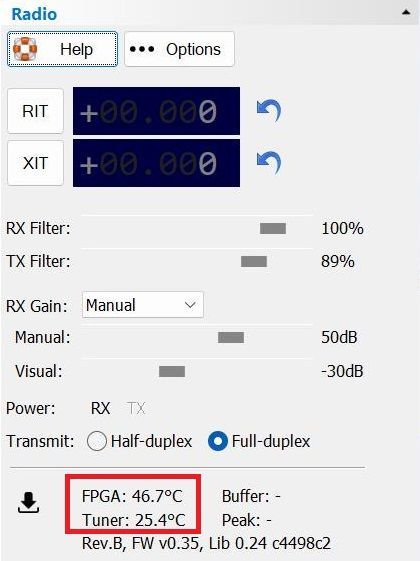
Using  scripts from Analog Devices the display is 20°C higher, so there's possibly an error in SDR Console. It only took a few minutes to find the problem - during early Pluto support I had added a fixed 20°C to reduce the displayed FPGA temperature to a value similar to the tuner.

Future kits will now show a correct value for the Pluto FPGA temperature as per the screenshot.


Update, October 14th 2024

Siegfried Jackstien (DG9BFC) reports that when starting Pluto the FPGA temperature is shown as 20°C higher than the tuner, even with a massive heatsink connected. This is obviously incorrect as on switch-on the temperature of both chips should be roughly room temperature.


As a result the fixed 20°C reduction has been restored.


Update, December 19th 2024

See this github post. "First of all the temperature readings are die temperatures. Even if you have a high thermal conductivity cooling solutions, the temperatures will never be the same."


So this explains the difference - the fact that these are die temperatures.

PDF with Github post.


SDRConnect IQ Files

October 7th, 2024: Currently adding support for the new SDRConnect IQ file format which is RF64 but implementing header fields and file chunks in a manner which is totally legal but confused SDR Connect.


The WAVE RF64 specification is here.


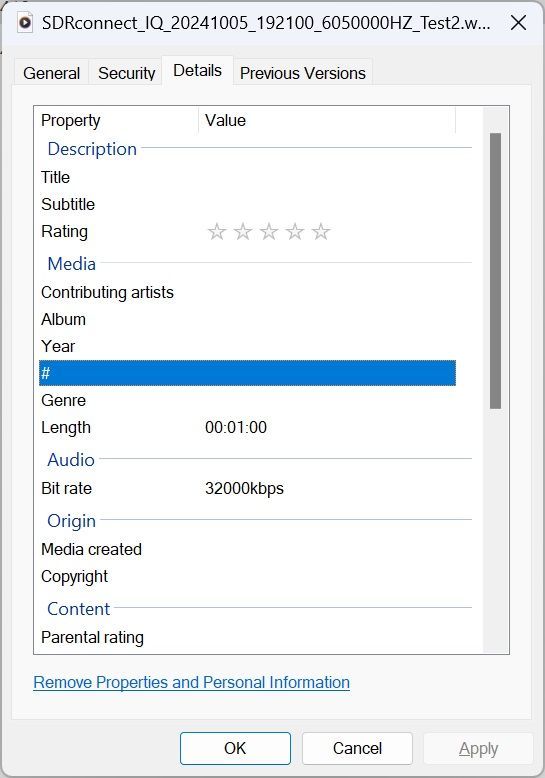
As an aside, an easy way to check that a WAV file is structurally correct is to simply display the properties as per the screenshot. If you see a value for both Length and Bit rate then it's OK.


Many thanks to Bjarne Mjelde in Arctic Norway for his help.
By Simon Brown June 12, 2026
SDR Television v1.1.2 June 12th, 2026: Add option to disable audio, thus making more bits available for video, this is for use in DATV contests. Note: 66 ksps sample rate is still experimental, will be improved. Downloads are at the bottom of this page. 
By Simon Brown June 9, 2026
SDR Television v1.1.1 June 9th, 2026: Fixes a fatal bug in the Settings, Camera page. Downloads are at the bottom of this page.
By Simon Brown May 23, 2026
Version 1.6.2 This release fixes two bugs in the new DX Spot feature. The spot age logic incorrectly affected spot display. When the map was zoomed, station markers off the map would be displayed at the top left (0, 0).  Downloads are on the World Map page . Version 1.6.1 This release fixes two fatal bugs in the new DX Spot feature. When the graphics engine is restarted, resources are correctly released. Fixed a resource leak when processing the MoseMove logic. Downloads are on the World Map page . Version 1.6 This release adds the display of DX Spots. Display spots are submitted to PSK Reporter which in turn are relayed by a MQTT Broker running on a high performance Akamia node. Spot Format Each spot consists of these fields: Sequence Frequency Band Mode Signal level Time stamp Sending station call, square, country Receiving station call, square, country Note: The country is the ADIF country. Spots are displayed as they arrive, currently no on-demand database. Bandwidth To reduce bandwidth from the broker, filtering is required for 80m up to and including 15m. Filtering requires at least one field below to be set in a definition: Receiver callsign, square or country. Sender callsign, square or country. Without filtering the bandwith from the broker could be excessive. For LF and VHF+ no filtering is required due to the lower number of spots sent on these bands. In a later version the bandwidth restriction may be reduced.
By Simon Brown May 21, 2026
Version 1.6.1 This release fixes two fatal bugs in the new DX Spot feature. When the graphics engine is restarted, resources are correctly released. Fixed a resource leak when processing the MoseMove logic.  Downloads are on the World Map page . Version 1.6 This release adds the display of DX Spots. Display spots are submitted to PSK Reporter which in turn are relayed by a MQTT Broker running on a high performance Akamia node. Spot Format Each spot consists of these fields: Sequence Frequency Band Mode Signal level Time stamp Sending station call, square, country Receiving station call, square, country Note: The country is the ADIF country. Spots are displayed as they arrive, currently no on-demand database. Bandwidth To reduce bandwidth from the broker, filtering is required for 80m up to and including 15m. Filtering requires at least one field below to be set in a definition: Receiver callsign, square or country. Sender callsign, square or country. Without filtering the bandwith from the broker could be excessive. For LF and VHF+ no filtering is required due to the lower number of spots sent on these bands. In a later version the bandwidth restriction may be reduced.
By Simon Brown May 20, 2026
Version 1.6 This release adds the display of DX Spots. Display spots are submitted to PSK Reporter which in turn are relayed by a MQTT Broker running on a high performance Akamia node. Spot Format Each spot consists of these fields: Sequence Frequency Band Mode Signal level Time stamp Sending station call, square, country Receiving station call, square, country Note: The country is the ADIF country. Spots are displayed as they arrive, currently no on-demand database. Bandwidth To reduce bandwidth from the broker, filtering is required for 80m up to and including 15m. Filtering requires at least one field below to be set in a definition: Receiver callsign, square or country. Sender callsign, square or country. Without filtering the bandwith from the broker could be excessive. For LF and VHF+ no filtering is required due to the lower number of spots sent on these bands. In a later version the bandwidth restriction may be reduced.
By Simon Brown May 19, 2026
SDR Television v1.1 May 18th, 2026: This is the official v1.1 release , code exactly the same as 1.0.16 which has survived testing for a few weeks. Lots of improvements since the last official kit. As with any software project, there's always room for improvements and new features, but for now here's a stable solution which works well with the QO-100 satellite. Many thanks to Sigi and the DATV test team. Downloads are at the bottom of this page.
By Simon Brown April 12, 2026
SDR Television v1.0.14 April 12th, 2026: A new kit, lots of improvements since the last official kit. As with any software project, there's always room for improvements and new features, but for now here's a stable solution which works well with the QO-100 satellite. Many thanks to Sigi and the DATV test team. Downloads are at the bottom of this page.
By Simon Brown March 13, 2026
SDR Television v1.0.9 March 13th, 2026: A new kit, lots of receive improvements since the last official kit. As with any software project, there's always room for improvements and new features, but for now here's a stable solution which works well with the QO-100 satellite. Many thanks to the DATV test team. Downloads are at the bottom of this page.
By Simon Brown March 11, 2026
First Impressions